
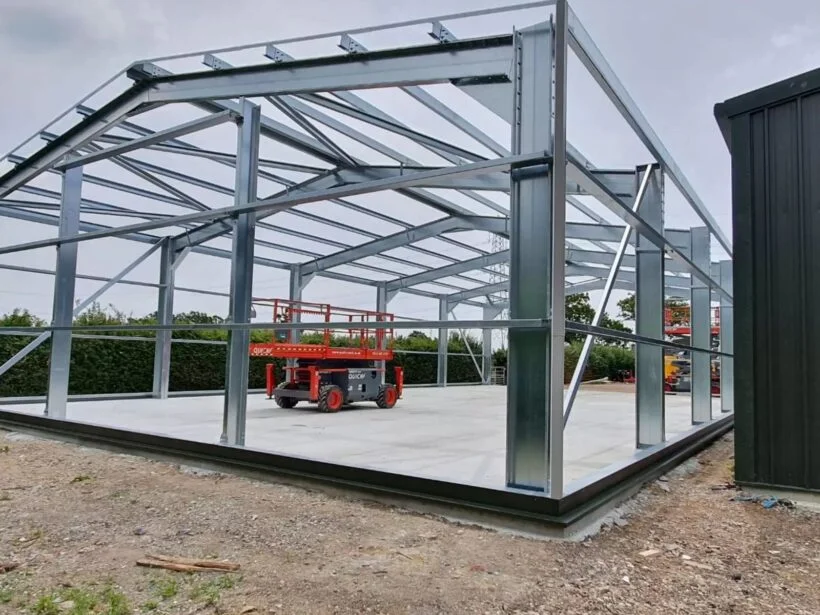
Steel or timber? It’s one of the first decisions on any new building, and the one people tend to make on instinct rather than evidence. Timber feels natural, familiar and traditional. Steel feels industrial and permanent. Both are legitimate ways to frame a building — but they’re good at genuinely different things, and choosing the wrong one is an expensive mistake to live with.
We build in steel, so you know where our bias lies. That’s exactly why we’ll be straight about where timber is the better answer.
Which Gives You More Usable Space?
Steel, comfortably. A steel portal frame can span the full width of a building with nothing in the middle — no posts, no internal walls, no obstruction. Timber can achieve respectable spans with engineered trusses or glulam, but as the width grows you’ll typically need intermediate supports, and those posts land exactly where you wanted to park a lorry or turn a forklift.
If your building is essentially a big open space that vehicles, plant or racking has to move around in, the clear span argument tends to settle the matter on its own.
Is Steel Cheaper Than Timber?
For small, simple structures, timber often is. For anything of commercial size, steel usually wins — and the reason is labour, not materials. A steel frame is fabricated off site to precise tolerances, delivered, and bolted together quickly by a small team. A large timber structure requires far more on-site carpentry, and site labour is the fastest-rising cost in UK construction.
The lifetime picture matters too. Timber needs periodic treatment, inspection and eventual repair. A galvanised steel frame with quality cladding is close to maintenance-free for decades. The cheapest building to erect is not always the cheapest building to own.
To compare properly, look at the whole cost rather than the price of the frame on its own:
- Materials. Timber looks cheaper per metre, but structural timber prices have moved about a lot in recent years. Cold rolled steel is made to order to precise sizes, and we buy ours from trusted British suppliers.
- Span. As a building gets wider, timber needs heavier sections or extra posts. Steel just gets a slightly bigger frame. On agricultural, storage and industrial buildings that’s where steel starts pulling ahead.
- Labour and build time. A steel frame arrives ready to bolt together, so there are fewer people on site for less time. That’s usually the biggest saving on a commercial job.
- Maintenance. Up here in the North East we get our share of wet weather, and timber left untreated will start to suffer. Over 10 or 20 years the treatment and repair bills add up. A galvanised steel frame doesn’t need any of that.
- Insurance. Because steel doesn’t burn, some insurers look more kindly on it (see the fire section below). Ask your broker before you decide.
Put all that together and, for commercial, industrial and agricultural buildings of any real size, steel almost always comes out cheaper over the life of the building. If you’re working out a budget, our guide to steel frame extension costs breaks down where the money goes.
How Do They Compare on Durability?
Steel doesn’t rot, warp, shrink, split or provide anything for insects to eat. It’s dimensionally stable through wet winters and hot summers, which matters more than people expect — timber moves with moisture, and movement eventually shows up in doors that stick and cladding that gaps.
Timber’s vulnerabilities are all manageable with proper detailing, treatment and maintenance. The question is whether you want a building that needs that discipline for the next thirty years, or one that doesn’t.
What About Fire?
Steel is non-combustible; it contributes nothing to a fire’s fuel load. It does lose strength at high temperature, which is why fire protection is specified where the building’s use or occupancy demands it. Timber burns, but heavy sections char predictably and retain structural capacity for a calculable period.
The practical point for most clients is insurance. If you’re storing vehicles, plant, stock or anything with real value, a non-combustible frame is frequently viewed more favourably by insurers — a conversation worth having with your broker before you commit either way.
Which Goes Up Faster?
Steel, in most cases. Because the frame is manufactured while the groundworks are underway, the two programmes overlap. When the steel arrives it goes together quickly and predictably, and it’s far less weather-sensitive than site carpentry — a significant advantage on a British construction programme.
Faster erection isn’t only about impatience. Every week the building isn’t finished is a week you’re not using it, and on commercial projects that’s usually the biggest number in the whole equation.
Which Is the Greener Choice?
Both have a genuine case, and anyone who tells you otherwise is selling something. Timber is renewable and stores carbon while it stands. Steel is energy-intensive to produce, but it’s the most recycled material on earth, contains substantial recycled content already, and can be dismantled and reused rather than demolished.
There’s also longevity to weigh. A building that lasts fifty years with almost no intervention has a very different footprint from one that needs continual maintenance and earlier replacement.
Does Steel Have to Look Industrial?
No — and this is where opinions are most out of date. The frame is only the skeleton. Modern cladding comes in a wide range of colours, profiles and finishes, and can be combined with timber, brick or render where the setting calls for it. Plenty of our buildings sit comfortably in rural and residential settings without announcing themselves.
That said, if you’re in a conservation area or a planning officer has been specific about materials, timber may be the shorter road. It’s worth establishing that before design work begins.
So When Is Timber Genuinely the Right Answer?
Small garden buildings, home offices and studios. Projects where planning conditions dictate materials. Domestic extensions on period properties where the finish has to match. Buildings where the exposed timber structure is the whole point aesthetically. In those situations, timber isn’t a compromise — it’s the correct specification.
For workshops, warehousing, agricultural buildings, vehicle storage, production space and anything needing clear span, height or serious durability, steel is the stronger choice on almost every measure that will matter to you in five years’ time.
The Verdict
Choose based on span, use and lifespan rather than on how the material feels. If you need open, uninterrupted space that will take heavy use for decades with minimal maintenance, steel is very hard to argue against. If you’re building something small, characterful, or bound by planning conditions on materials, timber deserves the job. Tell us what you’re trying to build and we’ll give you an honest answer — including if we think steel isn’t it. Our case studies show the range of projects we’ve delivered across the UK.
Request your free quote and we’ll respond within 48 hours.