
It’s one of those questions that sounds simple but gets complicated the moment you dig into it. Is steel cheaper than wood? The honest answer is: it depends on what you’re measuring. And that’s exactly what we’re going to break down here.
If you’re a business owner, farmer or property developer in the North East weighing up your options for a new commercial or agricultural building, this is well worth a read before you make any decisions. The upfront price tag tells only part of the story.
Why the Question Is More Complex Than It Looks
A lot of people look at the material cost of timber and assume wood is the budget-friendly option. And to be fair, that assumption used to hold more weight than it does now.
The cost of structural timber has increased significantly in recent years, driven by strong demand and supply chain pressures. Meanwhile, cold rolled steel, which is what Hamilton Steel Buildings uses for every project, is manufactured to precise specifications in the UK and priced consistently.
But material cost is just one piece of the puzzle. To really understand which is cheaper, you need to look at the full picture: build time, labour, maintenance, lifespan and long-term running costs.
Upfront Costs: How Do Steel and Timber Compare?
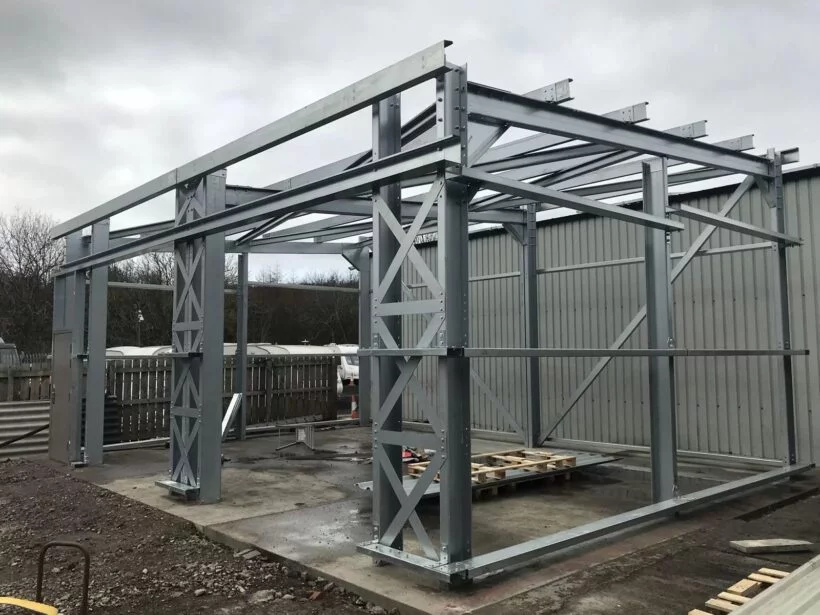
For a straightforward commercial or agricultural building in the North East, cold rolled steel frame construction is highly competitive on upfront costs. The components are precision-manufactured off-site and designed to bolt together quickly on site, which keeps labour costs down.
Timber framed buildings can vary enormously in price depending on the grade of wood used, the complexity of the design and the size of the build. For larger spans, particularly in industrial, agricultural or storage applications, steel becomes an increasingly cost-effective solution because you can cover greater distances without needing internal supports.
(If you’ve ever been inside a timber-framed agricultural building that’s full of posts and beams getting in the way of your machinery, you’ll know exactly what we mean.)
Build Time: Where Steel Really Pulls Ahead
One of the areas where steel consistently beats timber on cost is build speed. Cold rolled steel buildings go up quickly. The components arrive fabricated and ready to assemble, and Hamilton Steel Buildings manages the entire erection process with a skilled team, meaning the project moves at pace.
Faster build time means lower labour costs. It also means your building is operational sooner, which matters a great deal if you’re running a business that needs the space.
Timber construction tends to be more labour-intensive. More tradespeople are typically required on site for longer, which adds up. For businesses in Durham, Newcastle, Sunderland or anywhere across Tyne and Wear, that difference in build time can translate into a very meaningful saving.
Maintenance Costs Over Time
This is where the comparison really shifts in favour of steel, and it’s a factor that often gets underestimated at the planning stage.
Timber requires ongoing maintenance. It needs to be treated regularly against rot, damp and insect damage. In the North East, where we get our fair share of wet weather, this isn’t something you can ignore. Left untreated, timber degrades, and repair or replacement costs can mount up significantly over a 10 to 20 year period.
Steel, on the other hand, requires very little ongoing maintenance. Hamilton Steel Buildings uses trusted British cold rolled steel suppliers, and the finished structures are designed to last for decades with minimal intervention. No annual treatments, no rot, no warping.
When you factor in the cumulative cost of timber maintenance over the lifespan of a building, steel often works out considerably cheaper in the long run.
Fire Safety: A Practical Consideration
It’s worth touching on this one because it has real financial implications too. Timber is combustible. Steel is not.
From a building insurance perspective, a steel framed commercial or agricultural building will typically attract lower premiums than an equivalent timber structure. Over the lifetime of a building, that difference in insurance costs adds to the overall cost comparison.
For businesses storing equipment, vehicles, livestock or stock, the fire safety credentials of steel are also simply good peace of mind.
What About Sustainability?
Timber is sometimes promoted as the more environmentally friendly option, and there’s a reasonable argument there when the wood is responsibly sourced. But it’s not quite as clear-cut as it’s sometimes made out to be.
Steel is fully recyclable and can be reused at the end of a building’s life. There’s very little waste in the manufacturing process because components are precision-made to specification. Hamilton Steel Buildings works exclusively with trusted British suppliers, so the supply chain is transparent and quality is consistent.
For a business that wants a sustainable, low-waste build with a long lifespan, cold rolled steel is a genuinely strong option environmentally, not just structurally.
So Which Is Actually Cheaper?
For commercial, industrial and agricultural buildings of any meaningful size, steel is almost always the more cost-effective choice when you factor in the full picture.
The upfront costs are competitive. The build is faster. The maintenance requirements are far lower. The lifespan is longer. And the fire safety credentials can reduce insurance costs over time.
Timber has its place, particularly for smaller domestic structures or projects where a specific aesthetic is important. But for a North East business owner looking to build a warehouse, workshop, storage facility or agricultural unit that will serve them well for decades, steel is hard to beat on value.
Get a Quote From Hamilton Steel Buildings
Hamilton Steel Buildings has been supplying and installing steel framed buildings across the North East for years, covering County Durham, Tyne and Wear, Teesside, Northumberland and everywhere in between.
Every project comes with free GA drawings and structural calculations, a dedicated project manager from start to finish, and a full turnkey service that takes the stress out of the whole process.
If you’re weighing up your options for a new build or refurbishment, get in touch for a no-obligation conversation. Call 0191 359 2339 or visit hamiltonsteelbuildings.com.